
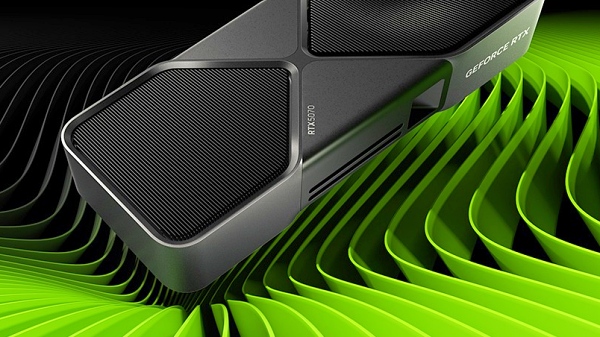
Nvidia is expected to break its annual gaming GPU launch streak dating back to the 1990s after not rolling out a new GeForce GPU generation in 2026.
On April 19 local time, major foreign media outlets including Cryptopolitan reported that Nvidia’s strategic focus has shifted from gaming to artificial intelligence (AI) chips, while an industrywide memory shortage has also made the product gap a reality.
The key to the shift is the profit structure. Nvidia’s computer and networking segment posted an average operating margin of 69 percent over the past 3 years, while its gaming graphics business stayed around 40 percent. Blackwell AI chips cost up to $40,000 each, compared with $299 to $1,999 for gaming GPUs, creating a wide profitability gap. Stacy Rasgon of Bernstein Research said, "Gaming used to be a growth driver, but it isn't now."
The market had also expected rivals AMD and Intel to benefit, but the reality is different. Both companies are also constrained by the memory shortage and are struggling to expand supply. AMD raised prices across its Radeon RX 9000 series by 10 to 17 percent, and Radeon chief David McAfee said, "Even with efforts to secure memory, it is not easy to keep prices stable."
Intel’s situation is more difficult. Intel has effectively scaled back its gaming GPU strategy. It had considered launching the BMG-31-based Arc B770 but scrapped the plan, and decided instead to focus on the workstation Arc Pro B70 equipped with 32GB of memory. The company said the gaming model lacked financial viability.
Behind the decisions is a structural shortage in memory supply. Nvidia plans to cut gaming GPU production by up to 40 percent because it has not secured enough memory, and Micron has also warned of a persistent industrywide memory shortage. Gartner forecast that PC prices would rise 17 percent this year and shipments would fall 10.4 percent. It also said entry-level consumer PCs could effectively disappear from the market by 2028.
A problem is that demand for AI chips is putting more pressure on general memory supply. High-bandwidth memory, or HBM, required for high-performance AI processors needs about 4 times more silicon wafers than general memory, increasing the supply burden. As memory resources are prioritized for AI, all chipmakers are facing the same bottleneck rather than it being a problem limited to specific companies.
Reactions in the gaming community are mixed. Greg Miller said he understands the reality that Nvidia is pursuing bigger profits, but it hurts, adding that gamers built Nvidia into what it is today. By contrast, game podcast host Tim Gettys said if Nvidia makes more money and shareholders are more satisfied, the company can leave gaming even if it was the starting point that helped it grow. He also said that since it is difficult to upgrade every year, the product gap could instead ease budget pressure.
In the end, supply constraints and price increases are expected to emerge as key variables for the 2026 gaming GPU market, rather than competition over new products. That is also why Nvidia’s absence is not immediately leading to an expansion of rivals’ market share. As long as the AI-centered reshaping of semiconductor demand persists, bottlenecks in the gaming market are also likely to continue for some time.
 Jinju Hong
hongjj@d-today.co.kr
Jinju Hong
hongjj@d-today.co.kr